Thursday, September 3, 2009

Google Chrome to be default Sony Vaio browser


Sony will deliver its Vaio line of PCs with Google Chrome installed as the default browser, and the Internet giant is said to be in similar talks with other computer manufacturers, the Financial Times reported.

The deal is a big win for Google, which has struggled to give Chrome a significant share of the market. In August, Chrome captured nearly 3 percent of the market, versus Internet Explorer's 67 percent and Firefox's 23 percent, according to Net Applications.

The agreement is Google's first with a computer manufacturer. Microsoft has similar deals with PC makers to make Internet Explorer their default browser, and IE comes with the Windows operating system in the United States.

From the Financial Times report:

Similar distribution alliances have become a key part of the internet search wars as Microsoft and Google vie to be the default search service on new PCs.

Google confirmed that Sony PCs carrying Chrome had started to go on sale and said it was in talks for similar deals with other computer makers. It said the arrangement was "experimental" and part of wider efforts to boost distribution, including a deal to make Chrome available to internet users who download the RealPlayer software and the company's first use of television advertising.

Along with Chrome will come Google as the default search engine on Vaio PCs. Many computers come with Google as the default, though many don't; Microsoft, for instance, has distribution deals with Dell, HP and Lenovo to make Bing the default engine on their computers.

Of course, users as always will have the option to use a different browser on Vaio computers.

"Competition in the marketplace is good, and people have the right to choose a browser that is best for them," a Microsoft spokesperson said in response to Google's announcement. "People will choose Internet Explorer 8 for the way it puts the services they want right at their fingertips, protects them from social engineered malware and phishing threats more than any other browser, respects their personal choices about how they want to browse and, more than any other browsing technology, puts them in control of their personal data online."

Source: Financial Times & Microsoft Blog

Tuesday, September 1, 2009

Review: Sony Vaio W Series

I've spent quite a bit of time with it. Let me now give you my conclusions. Fantastic!

The keyboard, even more fantastic. It doesn't have that eraser little thingy inside that is really irritating on the Sony P. This one has a good trackpad. Springy keys, I love the way these are. These pebble keys, ever since Mac started doing it and everyone started following. Keep doing it, don't change and go back to those ugly keyboards.

Good resolution on a 10" screen. The resolution is not that startling that you start thinking that you've grown really old, because it's not that small in text. Good enough at about 1366x768. Fantastic!

Multimedia seems to be a great focus in this particular product because, in every way possible they've crammed it with multimedia features. Including the fact that you can use it as a DLNA server, which means you can stream from here on to your TV or your playstaion 3. So all of that is good.

So what's not good? Obviously the battery life. I don't think that any netbook in the world should be sold with anything less than eight hours of battery life.

I don't care if that battery sticks out a little, I'll go with ugliness in one part of a netbook if it can give me eight hours of battery life. Three hours on a netbook? The very idea of a netbook is that I can carry it, travel with it, that I don't have to think of carrying an adapter with it. What's the idea if its only three hours?

What's then the final conclusion? The price point. A netbook should be priced at a certain price point. Even if it's premium it can't go way over.

The Sony Vaio P broke that rule. At Rs 50,000 to Rs 60,000, I could have brought three netbooks. This one is priced low (at Rs 29,990) and its priced very attractively for a Sony, but is it priced right for a netbook?

Pros
Keyboard
Multimedia features
Screen size and resolution

Cons
Battery life
Higher-end price tag

Good improvement by Sony yet it could have been better.

Monday, August 31, 2009

Worth The Weight


You know, it wasn’t all that long ago when most PC manufacturers dismissed the netbook phenomena as “a race to the bottom”. Turns out the bottom is the place to be, what with almost everyone launching their own version of the oft-repeated netbook-specification components. And while it may well be the last through the gates — there’s no confirmed netbook news from the last bastion (Apple) yet — will the VAIO W, Sony’s first real netbook offering, be the one to beat?

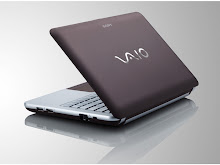
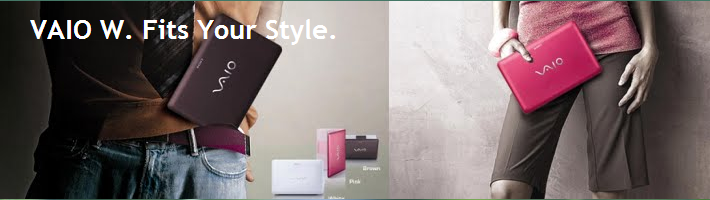
To be fair, Sony’s tested these waters earlier this year with the ‘it’s not a netbook’ VAIO P. Certainly, the VAIO P’s price (at over Rs. 60,000) kept it out of netbook waters. With the VAIO W’s Rs 29,990 pricing, it’s clear that Sony’s looking at the premium end of the netbook market. To that end, Sony’s made the effort to impart a sense of luxury to the W-series. It’s available in berry pink, sugar white and cocoa brown, and looks like a scaled-down version of the company’s mid-range laptops, which is a rather nice design inspiration to begin with. The bold VAIO logo on the lid, the isolated keyboard design, bright textured plastics and curved edges all give the W-series a distinctive sense of style and robustness. Sony’s paid some attention to colour on the inside as well, with a textured wrist-rest that's a lighter version of the netbook's primary colour.

Now while Sony still shies away from using the term 'netbook' (this one is officially referred to as a 'mini notebook', the guys at Sony are the first to admit that it is one. After all, the Vaio W does boast of the familiar feature-list and specification that we have come to know as 'netbook spec' — an Intel Atom Processor N280 (1.66GHz), 1GB RAM, 160GB HDD, Wi-Fi, Bluetooth, Motion Eye webcam, a couple of USB ports. Then there are the goodies — draft-n wireless and Bluetooth. There’s enough speed under the hood to cope with undemanding tasks — the usual web browsing, word processing and even web streaming will work reasonably well. Don’t expect beautiful, smooth video though — with Intel’s GMA 950 graphics chip in place, video playback was always fighting a losing battle and I found it stuttered with heavy encoded files.

The standout feature in the VAIO W is clearly its LED-backlit screen. At 10.1 inches, there’s nothing unusual about the size, but it’s miles ahead of the competition when it comes to detail. It’s got a native resolution of 1366 x 768 pixels, and while this may not sound all that great, it’s among the sharpest I’ve seen on a panel of this size, and puts the 1024 x 600 pixel screens on most rivals to shame. No more excessive scrolling to view your documents in full — the higher resolution is great for daily use, with websites easily fitting onscreen, and the widescreen aspect ratio ideally suited to movie playback. Colour, brightness and contrast are also excellent, and while the screen is cramped as compared to a full-size laptop, it’s just right to use for extended hours of web browsing. LED backlighting also offers excellent colour reproduction, although the glossy finish reflects a bit too much in bright conditions.

Other than that, I liked the chiclet keyboard — it's 86 per cent full size so takes a little getting used to, but there's plenty of travel in the keys and the feel is decidedly premium. Also, along with a Memory Stick slot, you’ll get an SD card slot. Overall, there a ‘complete’ feel to the laptop, a product which is well sorted out straight from the start.

Which is why it is absolutely disappointing to see a measly 3-cell battery on this baby — with a claimed battery life of 2.5 hours, this is well below the netbook average of around 4 hours, and much below the 8-hour best of breed netbooks. A six-cell battery will be available soon, which should approximately double the battery life, but given the fact that many cheaper netbooks ship with six-cell batteries, this will hurt your wallet all the more. And with the competition being as tough as it is, this rather likeable netbook may need to go further for the money to get the attention it deserves.


Quick Specs:

VAIO W — VPCW115XG/P,/T,/W

Processor: Intel Atom Processor N280 (1.66 GHz)

Operating System: Windows XP Home Edition with Service Pack 3

Chipset: Mobile Intel 945GSE Express Chipset (667 MHz bus) with Intel Graphics Media Accelerator 950

Memory: 1 GB DDR2 SDRAM

Hard Drive: 160 GB (Serial ATA, 5400 rpm) (no optical drive)

Display: 10.1" wide (WXGA: 1366 x 768) TFT colour display

Interfaces: 2 x USB 2.0, VGA display connector, Network (RJ-45) Connector, headphone, microphone, Memory Stick Slot, SD Memory Card Slot

Wireless: Integrated Wireless LAN IEEE 802.11b/g/Draft n, Bluetooth 2.1+EDR

Camera: 640 x 480 pixels

Battery: VGP-BPS18 Lithium-ion battery: up to 2.5 hours of use

Included software: WinDVD for VAIO, VAIO Media Plus, VAIO Control Center, WebCam Companion, Magic-i Visual Effects, VAIO Recovery Utility, VAIO Update, Roxio Easy Media Creator, Adobe Reader 9

Dimensions (W x H x D): 267.8 x 27.5-32.4 x 179.6 mm

Weight: 1.19 kg (including the supplied battery)

Rating: 8/10

Price: Rs 29,990

URL: http://www.sony.co.in/

Source: Businessworld

Thursday, August 27, 2009

Sony's New Vaio W Netbook


CIO has a picturesque review on Sony. Here are some excerpts from the article:

"Sony today took the first step into the netbook market, introducing the Vaio W line of mini laptops.

Featuring a high-resolution 10.1-inch screen (1,366 by 768 pixels), Sony's new netbooks can fit more information on their displays than regular netbooks.

The Sony W measures 10.6 x 7-inch, is just over one inch thick (not including protrusion) and weighs just under 42 ounces.

Available in three colors (white, pink and brown for business users), the Vaio W comes with a processor running at 1.66 GHz, runs Windows XP, and has 1GB of RAM.

Sony's new netbook series will ease your pockets (or credit cards) of $500 when it goes on sale in August. Sony's Web site is open for pre-orders now."

Logon to CIO for the complete review on VAIO W Netbook

Sony VAIO W-Series Netbook - User Review

When it comes to netbooks, Sony has exhibited the kind of reticence that allowed Apple to muscle in on the portable media player market it so long dominated. After the super-expensive and largely pointless P-Series 'lifestyle' something or other, it finally announced its first genuine netbook last week, the W-Series. Earlier in the week I had a little time to take a closer look, so here are my first impressions of Sony's first netbook.

I'll deal with the normal pleasantries now. While this is indeed the first Sony netbook, it is restricted by most of the same rules as everyone else. This means you'll get an Intel Atom N280 processor, 1GB RAM and a 160GB hard drive. There's Wi-Fi and Bluetooth too, while there's a webcam for video chatting and the like.

This just leaves the major headline: the display. It looks as though the W-Series will be the first netbook to take advantage of Intel's newly relaxed rules regarding netbooks by utilising a 1,366 x 768 resolution, 10in display. Naturally it's LED backlit, just like every other netbook, but the resolution is a massive improvement for a 10in netbook and we fully expect Asus, Acer, Samsung and the rest of the gang to follow suit just as soon as they are able.

As for the display itself, on first inspection it's a bit of a stunner. Being a relatively high resolution for such a small display means it has a very high dot pitch, so is razor sharp. This might prove challenging for shorter sighted folks, but if every netbook starts shipping with a screen of this resolution I (for one) won't be complaining. On a more negative note, though, the W-Series follows the trend toward reflective glossy displays. Netbooks with anti-glare displays are few and far between these days!

Connectivity is the usual fare, with three USB ports, a VGA output, audio jacks, an Ethernet port and an SD card reader on-hand. One change is the inclusion of an obligatory Memory Stick reader, a regular feature of every Sony notebook, though one few are likely to use. Were a prize for bloody-minded persistence on offer, Sony and its proprietary memory could run Toshiba (it of Blu-ray denying fame) pretty close!

From a design standpoint the W-Series is an undoubted success. Visually it's a bit like a slightly more refined version of the Toshiba NB200-10Z, which itself appeared to have more than a little Sony influence in its design. Like the company's NS-Series of notebooks, the body of the machine is a textured plastic, albeit finer and smoother to the touch. On the lid, meanwhile, the W-Series is finished in a smooth matte plastic that should be more durable than some of Asus' recent offerings.

Sony will also be selling the W-Series in different colours, with brown, white and pink being on show. It has also created matching accessories, including slip-cases and mice. They're very nice, too, though Sony won't be shipping the machines with the slip-cases, so be prepared to pay a little more for the those.

Vital to any netbook is the keyboard and if there's an area where the W-Series might polarise opinion, this would be it. Like most Sony laptops it has an isolation-style keyboard and it looks very cool. We even like the key action, which is quite different to most. While the key travel is very shallow, even by Sony's normal standards, the keys have a very snappy and light feel that works rather well. It takes a little getting used to, but after a couple of minutes I was quickly up to speed.

So, what's the problem? First, there's the size of the keys; they're just a bit on the small side. Probably not small enough to be a deal breaker, but compared to any of the latest 10in netbooks they're definitely smaller - I'd liken the Sony to the original Acer Aspire One and the D150 in this respect. My real gripe, though, is a bit of a perennial classic - the right-Shift key. It's just tiny, no bigger than a normal key, though it is at least positioned fairly sensibly. Overall, the keyboard isn't bad per se and in some ways it's actually very good, but there are one or two quirks to contend with and while I liked the key action, it's easy to imagine others not agreeing.

While larger 'extended' batteries for the W-Series have been pictured, the retail machines won't ship with them. We weren't able to ascertain the size and capacity of the provided batteries in our time with the machines, but given the W-Series weighs around 1.19kg it's probably a three or four-cell unit. Of course, as the Asus Eee PC 1008HA demonstrated, this needn't mean bad battery life, so it's impossible to pass judgement on that right now.

As yet Sony hasn't settled on a final price for the W-Series, though a release in August at around £400 were the figures discussed with us. Given this is Sony and it has a unique feature (i.e. the high resolution display) up its sleeve, this isn't a terrible price. Overall, Sony appears to have many of the right ingredients for an excellent netbook, but how long until Asus et al jump on the bandwagon? If and when they do might be the deciding factor in the W-Series' success.

Source: www.trustedreviews.com

Tuesday, August 25, 2009

The netbook grips the market


In today’s world of convenience and convergence, most working professionals would confess to being acutely dependent on the computer and the Internet. How about then, if these essentials come together in a lightweight platform that you could carry around anywhere? This is exactly what you can do with the smaller and no-frills netbooks that many PC manufacturers are releasing these days.

Ever since the launch of Intel’s Atom processor, the same size as that of a one-rupee coin, computer makers have been engaged in a war to woo customers and establish themselves as the market leader in the netbook segment. But the problem is: With something as small as a 200-page hardbound book, how do you set it apart from competition?

There’s little room in terms of adding features to a netbook. A netbook is essentially a no-frills PC for the casual user. This means that there’s usually no CD ROM drive and at times very little hard disc space than its bigger brother, the notebook. Moreover, the computing power is also lower than a conventional notebook. This, however, results in a longer battery life.
The main concept behind the netbook is that it’s a light machine, used mainly to connect to the Internet. As the pricing and positioning of the product differs, companies add on features like a camera or a high resolution screen. Some have even moved out of the generally accepted specifications of netbooks to offer an even higher disk storage space, but at a premium obviously.
Low pricing

Lower pricing than laptops is one of the most attractive features of netbooks. Says a spokesperson for Sonal Infosoft India, a multi-brand PC dealer, “Economy brands like Acer, ASUS and HCL tend to show more sales, purely due to their pricing. They fall in the Rs 18,000 to Rs 21,000 range.”

Says Acer’s Chief Marketing Officer, S. Rajendran, “Highly portable, netbooks are becoming increasingly popular as they allow users to hook onto the internet anytime from anywhere. The pricing is around Rs 20,000; and with this category proliferating with variants (higher screen sizes and gesture sensitive touchpads), the price band stretches up to no more than Rs 25,000.” In 2008, ASUS was one of the first companies to bring out netbooks. Priced initially in the sub-Rs 20,000 category the company has now expanded its portfolio after witnessing surging demand from consumers. Says Stanley Wu, Country Head, Notebooks & Eee PC Business, ASUS India, “India is an upcoming consumer hub for diverse computing products. The first Eee PC was launched in India in January 2008 and it received a great response from the consumers. ASUS has rolled out many models of the Eee PC and our products are in the price range of Rs 21, 000 to Rs 31,000.”

Sumanata Mukherjee, Lead PC Analyst, IDC India, says: “Asus and HCL launched their Netbook models early in 2008 and so were able to get a first-mover advantage in this new, emerging segment. The pricing decisions of the respective netbook vendors is a result of the positioning they have selected for their Intel Atom processor-based offerings.”

Lifestyle computing

But not all companies have a similar market strategy. Catering to the premium segment, Sony prefers marketing its smaller laptop, the Vaio P, as a ‘lifestyle PC’, rather than a netbook. “The smallest PC that we have is Vaio P, easily mistaken as a netbook. It is the size of a business envelope, roughly as thin as a cell phone and easily slips into a pocket or a handbag,” says Sachin Thapar, Head, Sales and Marketing, IT, Sony India.

Essentially, there is little difference between other netbooks and the Vaio P series. Similar to netbooks offered from other companies, these too run on the Intel Atom processor, mostly offer lesser storage capacity and have no optical drive. However, the price band of Rs 50,000 to Rs 65,000, coupled with features such as camera, high screen resolution and snazzy design, puts the Sony Vaio P in a class of its own.

However, unable to stay away from the rapidly growing market, Sony recently announced the Sony W series, according to media reports. With its global launch in August, the company may finally enter the netbook market officially.

Another company which has successfully marketed lifestyle computing is Hewlett-Packard. HP was at the forefront of offering trendy designs on notebooks and has now introduced it in its netbook range. Priced slightly higher than its competition, it is designed for the fashion conscious consumer.

Says Diptesh Ghosh, Country Manager, Consumer Notebooks, HP India, “The HP Mini is designed for people who want a light-weight notebook with premium appeal at affordable pricing. A specific target segment is the working women who need a laptop that is light on shoulders, great on performance and heavy on the style element.”

Popular among business executives

When netbooks initially came out, people thought it would be more popular among students and the young crowd. However, an equally big market has been the business executives and professionals who need the Internet on the go.

Says Ranjit Yadav, Director - IT, Samsung India, “Our netbooks are targeted at the household consumers – young students, professionals who do not have heavy computing needs as well as business executives who travel a lot and would like a light and dependable machine to access the Internet and meet their computing needs while on travel.”

Even ASUS agrees that the minimalist features of netbooks are a huge attraction for business executives. “The netbook is a perfect companion for professionals, students and businessmen, specifically for people who travel a lot. The trend is catching up as we see people opting for a netbook as compared to a conventional notebook due to their own basic requirements, such as surfing and office applications,” says Wu.

Acer’s Rajendran concurs. He says, “The netbook is likely to be adopted faster by SME executives and government officials due to its USP of being a compact, affordable and connected machine.”

Growing Segment

Netbooks have been revolutionary in creating a whole new segment in the personal computers market. Says IDC analyst Sumanta Mukherjee, “While the initial netbook models that hit the market were ‘stripped down’ versions of their notebook PC cousins, later models also feature hard disk drives. In this avatar, netbooks have been able to open a niche market of casual computer users – primarily net surfers and executives looking for a lighter, no-frills PC for use during travel and business meetings. This segment would be interesting to watch in the months ahead.”

According to IDC figures, when netbooks first came into the market in 2008, 37,000 units were shipped into India, compared to 2.3 million units of notebook PCs. But, this year the industry is projecting much larger sales figures. The unanimous opinion from companies is that this segment would grow very fast, with netbooks soon becoming an important part of their product line-up.
While ASUS feels the Indian netbook market would double itself this year, Samsung expects netbooks to contribute 50 per cent of its total notebook sales this year. Samsung also aims to garner a 7-8 per cent share in the Indian market by next year.

Acer, which already has a 40 per cent market share in the Indian market, sees a tremendous potential in India. “We expect netbooks to be popular in India too, especially among small and medium businesses, and also as a second computing device in upper-middle class homes.
We expect the Indian netbook market to be around 3 lakh units this fiscal year,” says Rajendran.
Indian computer major HCL is equally bullish about the netbook market. Says George Paul, Executive Vice-President, HCL Infosystems, “Going forward, the market for netbooks looks promising, as its demand will rise gradually with the increasing availability of internet bandwidth and GPRS/3G mobile connectivity across the country.” Clearly, the netbook is ready to slip into more bags.
Review: Sony Vaio W netbook

The show takes a look at product specifications and price of Sony Vaio W netbook and telepresence and teleconferencing solutions for banking. Various features of Microsoft's Zune HD are also compared with iPod Touch.


Source: NDTV Tubaah